
Sibley County Warrant Search
No official Sibley County active warrant search page was located on the Sibley County Sheriff's Office site. The sheriff directory lists a Warrants / Criminal entry at 419 Harrison Street with the Sheriff's Office main phone, 507-237-4330. Search results also surfaced a 507-237-4051 listing tied to Warrants / Criminal, which overlaps with court administration. Because those numbers conflict, the safer official path is to use the Sheriff's Office main number for law-enforcement warrant questions and Sibley County Court Administration for court-issued warrant questions.
The Sheriff's Office is the law-enforcement office for Sibley County. It patrols the county, investigates crimes, operates the jail, handles civil process, and provides contract policing to several communities. The official sheriff page is one of the warrant research sources.
In practice, a warrant may show up as a missing-hearing issue, a probation matter, a bench warrant tied to a district court case, or a search warrant that never becomes broadly public. That is why the county record trail usually starts with the sheriff, then checks MCRO, then checks the court file, and only then uses the jail roster if the person is already in custody. The county attorney and district court pages help when the warrant is connected to an active criminal file rather than a pure law-enforcement hold.
The sheriff page gives the local law-enforcement starting point, but it does not replace a direct warrant-status confirmation by phone or in person.
Sibley County Sheriff's Office
419 Harrison Street
Gaylord, MN 55334
507-237-4330
Administration: 8:00 a.m.-4:30 p.m. Monday-Friday
Jail and dispatch: 24/7
Sibley County District Court
400 Court Avenue
Gaylord, MN 55334
507-237-4051
8:00 a.m.-4:30 p.m. Monday-Friday
Sibley Warrant Access Channels
The warrant fallback chain in Sibley County is specific. Use the sheriff for active law-enforcement confirmation, the court for bench warrants tied to District Court cases, MCRO for public case entries, the criminal complaint viewer for filed complaint context after August 26, 2021, and the jail roster for people already in custody. The jail roster does not list all outstanding warrants.
County sources are more useful than a third-party warrant database because they show which office actually controls the record. A sheriff contact can tell you whether the warrant is still active. Court Administration can tell you whether a hearing was missed or reset. The County Attorney's complaint viewer shows what charge led to the case, but it does not itself prove warrant status.
- Call the Sheriff's Office and ask whether a warrant check can be confirmed through the Warrants / Criminal contact.
- Call Sibley County Court Administration for bench warrants tied to missed hearings or filed District Court cases.
- Search MCRO Case Search by name or case number for public case activity.
- Check the Sibley County jail roster only for people currently in custody.
- Use the County Attorney's complaint viewer for criminal complaint context, not as proof of active warrant status.
The sheriff staff directory is one of the official sources documenting the records, civil process, jail, warrants/criminal, and tip-line contact structure.
The directory supports the local fallback path, but it should not be treated as a searchable warrant database.
Types of Sibley Warrants
Warrant terms matter because each type has a different access and resolution path. An arrest warrant authorizes arrest based on charges or probable cause. A bench warrant is commonly tied to failure to appear, probation violation, contempt, or failure to comply with a court order. A search warrant authorizes law enforcement to search a person, place, or property and may be sealed before or after execution. A probation violation warrant is tied to alleged violation of supervision conditions.
In Sibley County, bench warrants are the type most likely to intersect with court calendar problems, while arrest warrants and probation warrants may move through the sheriff and jail first. Search warrants are often the least visible because they can remain sealed or partially sealed depending on the case. If the public needs to know which type of warrant exists, the sheriff and court office have the real answer.
- Arrest warrant: tied to alleged criminal conduct or a filed charge.
- Bench warrant: often tied to a missed hearing or court order violation.
- Search warrant: usually not public before execution and may remain sealed.
- Probation violation warrant: tied to supervision conditions after a sentence.
- Out-of-county hold: controlled by the issuing county or agency.
Sibley Warrant Record Fields
An official active warrant listing was located in the regional custody/warrant research set, but the visible sample appears to use another county's case numbers rather than Sibley County. It is useful only as a field pattern. Sibley County court cases usually begin with 72, so sample case numbers beginning with another county number should not be treated as Sibley warrant content.
| Field | What it means |
|---|---|
| Warrant number | Unique warrant or case-linked number, not always the same as the court case number. |
| Name | Person associated with the warrant. |
| Date of birth | Identity field used to distinguish people with similar names. |
| Date of warrant | Date the warrant was issued. |
| Offense level | Felony, gross misdemeanor, misdemeanor, or related level. |
| Description | Short offense or reason, such as failure to appear or theft. |
The regional active warrant listing was captured as a field-inventory source, not as a Sibley County list.
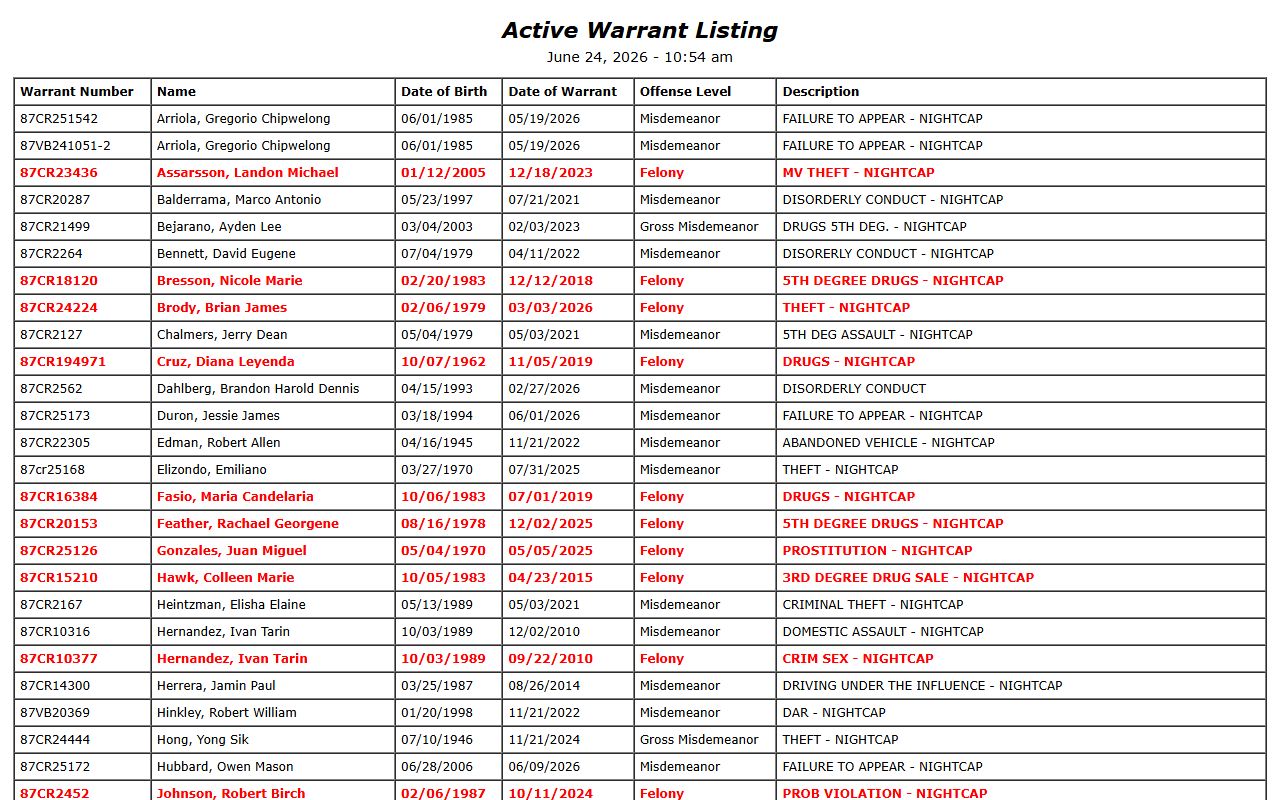
Use field patterns from that source carefully, and confirm any Sibley warrant with the sheriff or court.
Resolve a Sibley Warrant
Anyone who may have an outstanding Sibley County warrant should avoid relying on unofficial lookup sites. Official confirmation matters because bond status, appearance requirements, case status, and clearance timing can change. If represented by counsel, have counsel contact the prosecutor or court about recall, quash, scheduling, or bond issues.
The safest resolution path is to confirm the case number, the issuing office, and the required appearance before showing up. Some warrants are cleared only after a judge signs an order, some are tied to payment or reset hearings, and some require direct law-enforcement action. A person who already knows the sheriff contact, the court administrator number, and the county attorney page can usually move faster than someone who starts with a third-party site.
- Ask whether the warrant is active and what case number it belongs to.
- Ask whether bond is set, whether a body-only appearance is required, and where to appear.
- Search MCRO for public case details, but treat sheriff or court confirmation as controlling.
- If the matter is a failure-to-appear traffic or misdemeanor case, ask whether payment or scheduling is allowed.
- After resolution, allow processing time for the warrant to clear from court and law-enforcement systems.
Note: Sealed search warrants and some active law-enforcement records may be withheld even when a related case is public.
Public Record Search
Sponsored Results